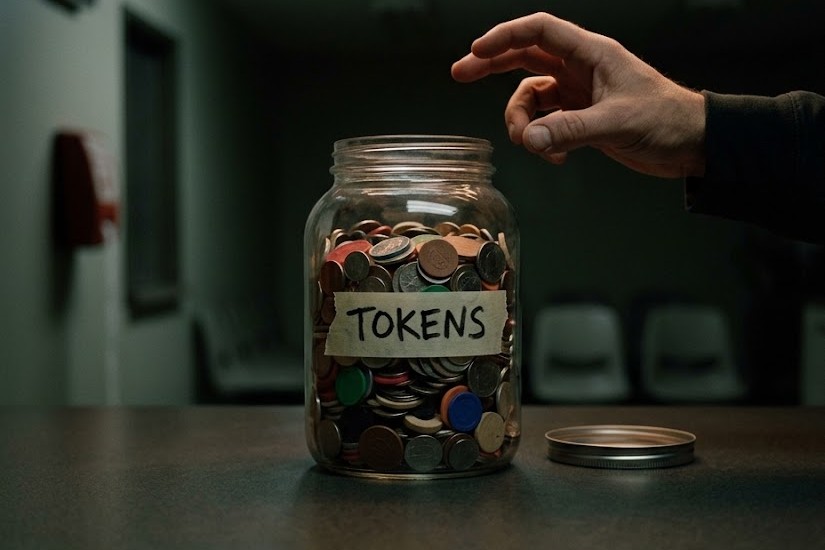
Every time I hit my company's AI token limit, I have to go ask IT for more.
They always say yes.
I still hate it.
It feels like getting caught. Like I did something wrong and now I'm asking for forgiveness. And there's a second or two, every time, where I genuinely wonder what happens if the answer is no. Can I still do my job? What do I say?
Then the worse thought. This is the second time this month. What does that look like from their side. Do they think I'm wasting it.
Nobody has ever made me feel that way. IT has been nothing but helpful. I invented the whole thing myself.
The calculation I never used to make
Before I try something now, I run a quick estimate of whether it's worth the tokens. Not whether it's a good idea. Whether it's worth the ask.
And if it's a maybe, an experiment I'd have run without thinking six months ago, I skip it.
Nobody denied me anything. I denied myself, quietly, and there's no record of it anywhere.
If you have a limit at work, you already know whether you do this. You can probably name the thing you didn't try last week.
The permission tax
I spend my time on product operations. Making teams faster, taking friction out of how work moves. So I recognize the shape of this immediately.
We put an approval queue in the middle of people's thinking.
Approval queues don't stop work. They change what people attempt, because now there's a social cost attached to trying something. We spent twenty years pulling those out of design reviews and deploys and procurement, celebrating every one we removed. Then we added a brand new one and nobody noticed, because it's measured in tokens instead of days.
Here's the tell: the answer is always yes. Nobody is enforcing anything. There's no gate, no denial, no budget conversation. And it's changing my behavior anyway.
That's not a budget. That's a norm. And norms are much harder to see, because there's no meeting where they get set and no ticket when they get violated.
The other end of it
A friend of mine has no limit at all. He mentioned on a call that he spends about $1,600 a week on tokens, the way you'd mention what you had for lunch.
I've thought about that number more than I expected to, and not because of the number. He builds things I wouldn't attempt. Not because he's better. Because it never occurs to him to ask whether an idea is worth trying. He just tries it.
Two people, same tools. One of us has a meter and one doesn't. The gap between us isn't budget. It's what we're each willing to start.
What to do about it
If you set the limit, you probably think you're managing spend. You're managing appetite. Those are different things and only one of them shows up on a report.
So try this. Go ask your team what they stopped asking you for.
Not what they need. What they quietly decided wasn't worth bringing to you. You'll get a real answer, and it will be uncomfortable, and it will be the most useful thing you learn this quarter.
Every organization has a version of this, and almost none of them are token limits. It's the tool nobody wants to request. The meeting nobody wants to call. The favor that costs a little too much social capital to ask for twice.
The bill was never the expensive part.