I led design for a $1.35B retail profit engine.
- My role
- Principal design lead — led a team of 4 (five people over three years, 100% retained), plus 2 designers and 1 researcher dotted-line for the program. Research through blueprint; co-owned MVP scope with PM
- The problem
- A $1.35B Kroger Alternative Profit business where 10+ teams disagreed on what problem was even being solved
- What I did
- Ran research and ideation to a 5-year directional picture, then service blueprints that became the alignment artifact. Partnered with 84.51° and product on the ROI case for what we did — and didn’t — build
- Outcome
- 150+ touchpoints mapped across 9 blueprints · scope discipline came free from the framing
Kroger — a Fortune 25 retailer doing $148B a year. Inside it sits the Alternative Profit business — credit, gift card, lottery, money services, compliance, sports betting, and the screens you see at every checkout kiosk. That business delivered $1.35B in operating profit in FY2024. I led design strategy across all of it, ran the design team, and partnered with 10+ teams across the company.
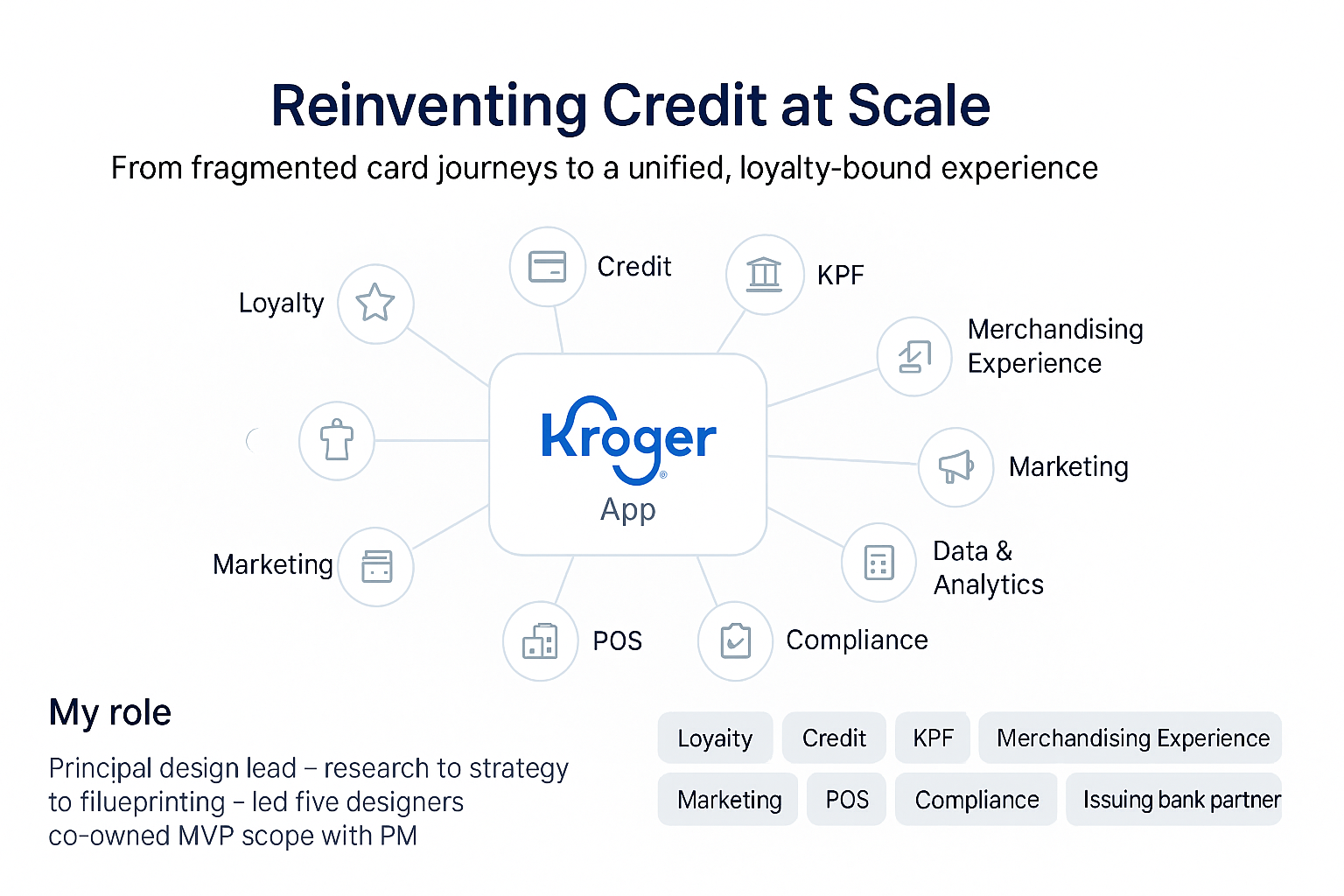
The vision that anchored the MVP
Before any blueprint or spec, we ran research and ideation on where this product needed to be in five years. Not a feature list — a directional picture of how the customer's relationship with credit should feel by 2030, and what role the retailer played in it. That picture became the constraint everything downstream had to serve. The MVP wasn't "the smallest thing we can ship" — it was "the smallest thing we can ship that's a real first step toward that future."
What the work actually was
Most of what I did there wasn't pixels. It was getting 10+ teams across the company to agree on what problem we were even solving. Service blueprints became the way I did that. Nine of them, across 150+ touchpoints, mapping how a customer experiences the financial ecosystem from the moment they tap a credit offer in the app to the moment they redeem points at the register six months later.
Once the blueprint was on the wall, the meeting changed. Engineering stopped arguing about their slice. Product stopped arguing about theirs. The conversation moved up a level — what should the customer feel here, what's the trade-off, what do we ship first. The blueprints stopped being deliverables and started being the language the org used to talk about itself.
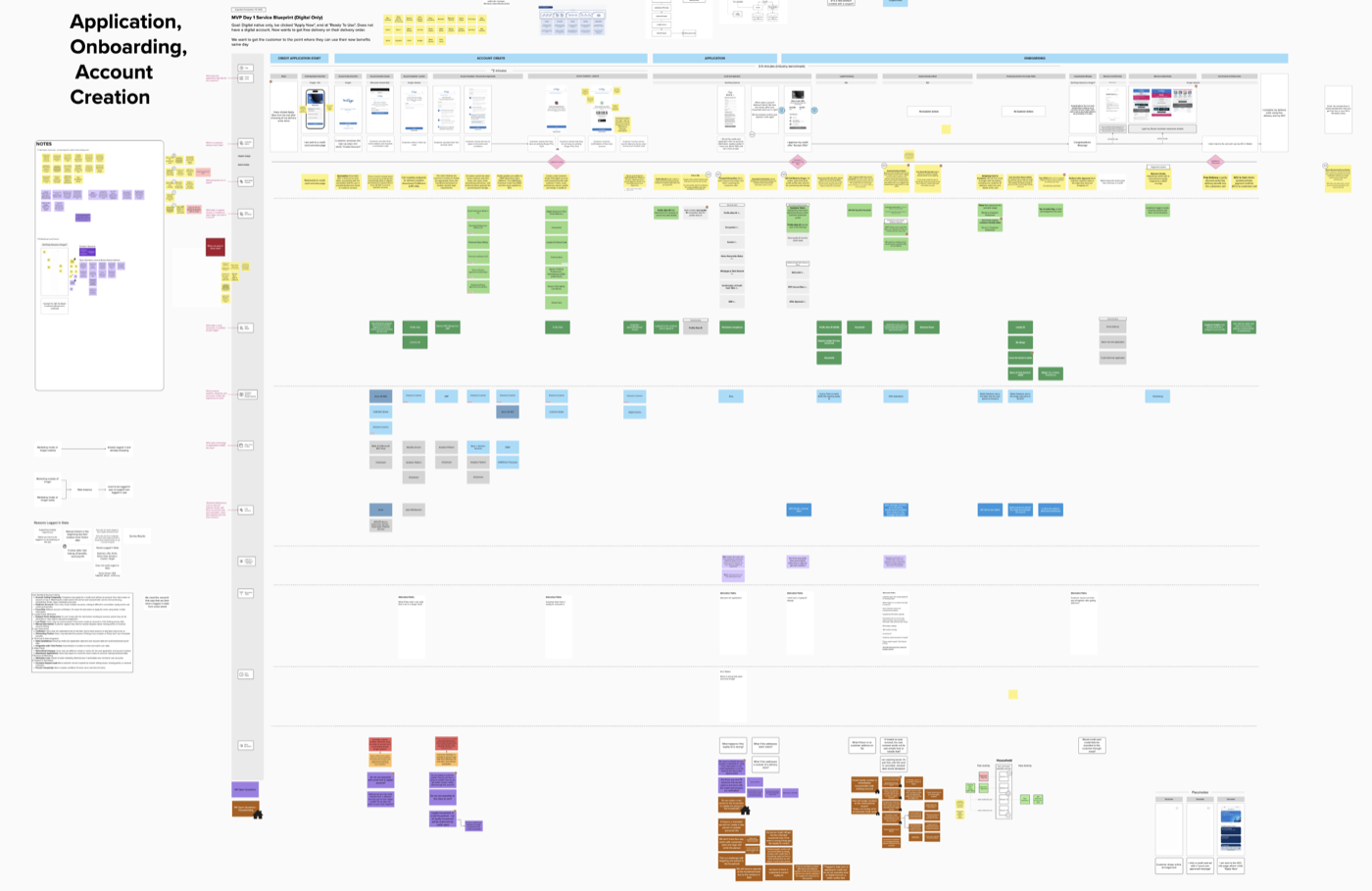
What it shipped to
The Credit Reinvention program — the flagship of the work — touched the application flow, the account creation experience, the dashboard, the offers surface, points, savings. Nine screens that customers used millions of times.
If a feature didn’t ladder up to the five-year vision, it didn’t make the cut.
The money part
I never held the budget — that wasn’t my role. What I held was whether we were pointed at something worth funding. I worked with 84.51°, Kroger’s data science arm, to pull the metrics behind a feature bet, and with the product managers to pressure-test whether a direction actually returned anything. Design gets a lot more say in the roadmap once it shows up with the ROI case instead of a rationale.
He has a laser-focus on business needs and is fully versed in the financial and operational aspects that drive product strategy. I learned a great deal from his ability to balance design excellence with budget and business priorities.
Dmitri led a talented team of four product designers, and under his leadership I watched each of them truly grow and thrive. His impact is evident in the success of the people he leads.
The team part
I held 100% retention through a major org restructuring — not because I'm a magnet, but because the work was strategic enough that designers wanted to stay close to it. We stopped being the team that made screens for other teams. We started being the team that decided what got built.
The early AI signal
Toward the end of my time there I started operationalizing agentic AI workflows — ChatGPT, n8n, Gamma — for research synthesis and executive deck creation. Days became minutes. At the time it felt like a small productivity win. Looking back, it was the prototype of the operating system I'd later build in retail tech and at Focus Agents. Same instinct, earlier, smaller scale.